
Utilize the NCWIT resources below to help inform yourself, participants, volunteers, and parents on the importance of computer science education for K-12 students, with a focus on broadening the participation of girls, women, and other underrepresented populations.
 The AspireIT Capacity Building Roadmap is designed to aid policy makers or those who are working at the state level to broaden participation in computer science in their community. Download this resource to learn about the state of CS in your state, discover how to talk about the importance of CS with others, find potential partners, and more.
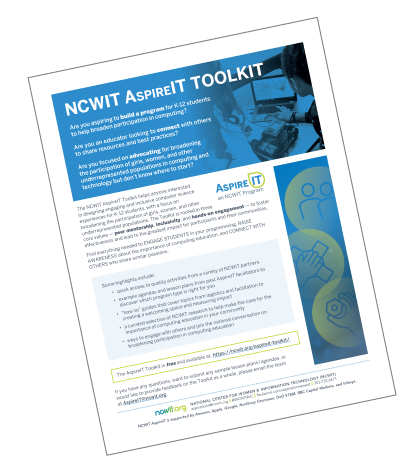 Download this one-page flyer to share with others everything the AspireIT Toolkit has to offer.
 Tell others about what you are doing! Download this Promotion Ideas document for ideas and resources on how to get press coverage.
STEM Next // Million Girls Moonshot Video Resource Library
After connecting with STEM Next and Million Girls Moonshot and creating the Capacity Building Roadmap to assist their 50 state afterschool networks to broaden the participation of CS in their states, the AspireIT team brought in various guest speakers to offer the networks support through a Community of Practice series of professional development workshops. Each session took a deep dive into equipping participants with the tools they need to advocate for the importance of computing education in their communities. Below, you can find video clips from this series to reference, use, and share.
The State of K-12 CS Ed
Sean Roberts, the VP of Government Affairs at Code.org, shares the state of CS in high school classes and outlines the organization’s policy ideas for making computer science fundamental to K-12 education and improving representation.
How to Facilitate CS Concepts
Guest presenter Hannah McDowell offers tips from CSTeachingTips.org and discusses how to use pair programming when teaching CS concepts, noting that this approach is engaging, beneficial for participants, and optimized for learning.
Building Equity from the Start
Jean Ryoo, an educational researcher from UCLA, discusses the growing body of research that is shining a light on how tech plays a central role in communities and influences everything in our lives, but only certain populations are benefitting.
Create a One-Day Event
Tanner Bergamo, AspireIT Program Manager at NCWIT, explains the three core values of the AspireIT Toolkit — including examples of each value in practice — and how you can use the AspireIT One-Day Event Guide in your community .
Find Partners to Collaborate
Karen Peterson, from the National Girls Collaborative Project (NGCP), talks about their organizational model and best practices for finding and building successful collaborations with partners and programs that engage youth in STEM.
Host a State Summit
Sarah Dunton, from the Expanding Computing Education Pathways (ECEP) Alliance, walks through the five-stage model of state change surrounding broadening participation in computing and outlines how summits can be pillars for advocacy.
Why Computer Science?
Top 10 Ways Families Can Encourage Girls’ Interest
Technology is a fast-growing, high-paying, creative field. Here are 10 ways that you, as a family member, can encourage the girls in your life to...Read More
Which computing pathway is right for me?
Find Your Future in Tech Are you curious about a career in technology but unsure where to start? From the foundational principles of computer science...Read More
Why Should Young People Consider Careers in Computing
What should you tell a young person about tech careers? How can they prepare now for a career in computing? Created for school counselors by...Read More
The Current State of Girls and Women in Computing
By the Numbers
Check out the most compelling statistics on women’s participation in computing on a single page.
NCWIT Scorecard: The Status of Women’s Participation in
The NCWIT Scorecard is a place you can find data on trends in the participation in computing in the U.S. over time by race and...Read More
Engaging Peer Mentors
Engagement Practices Framework
The NCWIT Engagement Practices Framework is a compilation of pedagogical and curricular practices that research suggests help engage all students,...Read More
Pair Programming-in-a-Box: The Power of Collaborative Learning
Pair programming is a collaborative learning method in which students program in pairs instead of individually. This approach significantly improves...Read More
The Beautiful Noise of Peer Instruction: An Interview
An often overlooked way to broaden participation in computing is to grow a more inclusive student community and culture. A...Read More
Engaging School Counselors
Top 10 Ways CS Educators Can Engage School
Engage School Counselors as Allies in the Effort to Increase Student Access to Computer Science School counselors are eager to...Read More