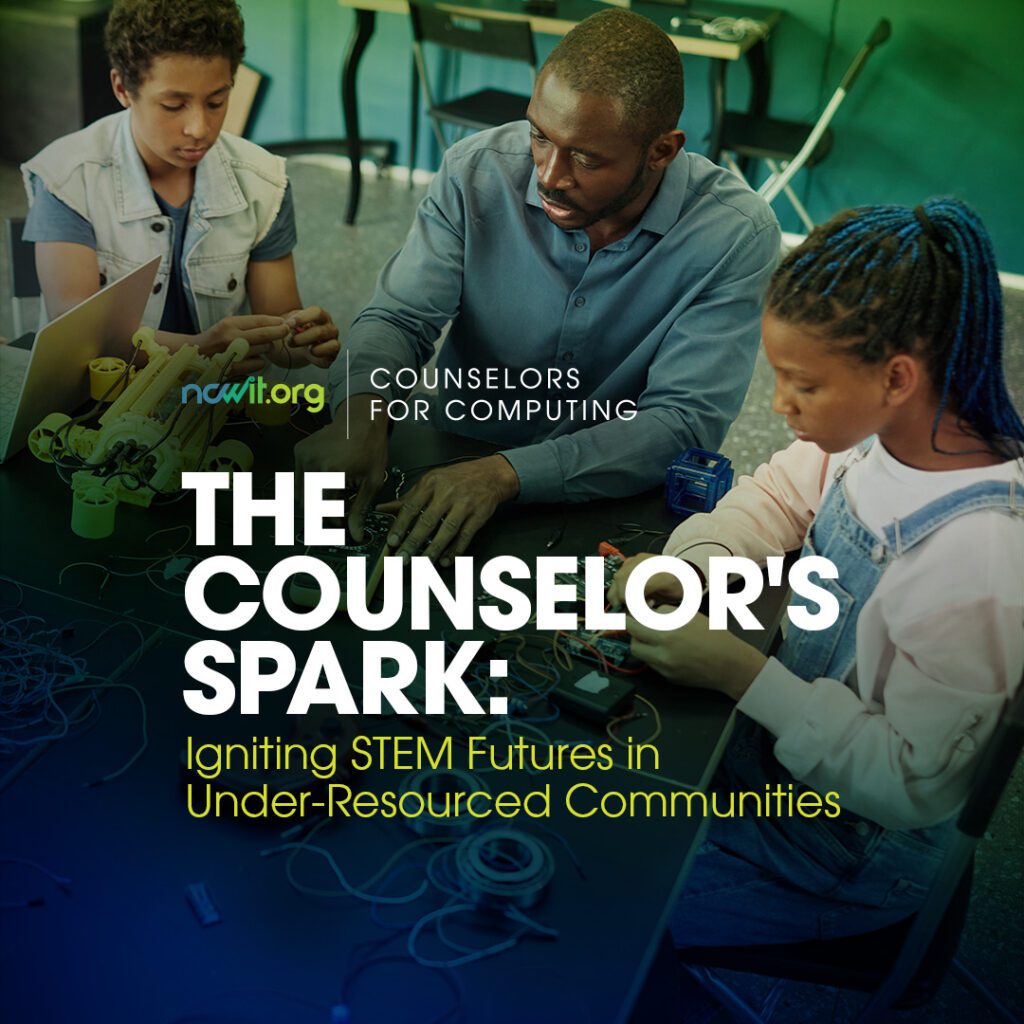
The story behind a recent STEM bootcamp in rural Alabama reveals the profound impact of dedicated educators and the power of community, showcasing how a school counselor can be a pivotal change leader in expanding access to computing and STEM education.
Kim Crumbley, an Alabama school counselor and an NCWIT Counselors for Computing (C4C) champion, initiated the idea after experiencing a heartbreaking event: A student from a challenging home environment was found salvaging old science materials from the school dumpster, retrieving items to be able to continue engaging in the science and tech that she loved during school hours. This moment spurred Kim to action, realizing that while a nearby summer STEM camp existed, the most vulnerable students in their high-poverty county simply couldn’t access it due to financial and transportation barriers. This firsthand insight is precisely why school counselors are uniquely positioned to identify students’ unique challenges and champion solutions.
Driven by a desire to provide opportunities, Kim connected with her school, the poorest in its county, with 82-85% free and reduced lunches, and they decided to host their own STEM camp. They capped the first camp at 40 students, reaching out to local businesses and organizations for financial support. A serendipitous connection led to a generous sponsor who, in honor of his late educator wife, fully funded the camp, even covering the cost of four teachers to assist with the event. The STEM camp showcased Kim’s commitment to the school counselor role in encouraging students to pursue STEM, and NCWIT’s Counselors for Computing mission. It incorporated themes from Author Kobi Yamada’s book What Do You Do With an Idea? What Do You Do With a Chance? What Do You Do With a Problem?, emphasizing the importance of giving children opportunities.
The four-day bootcamp, with half-day sessions, served students from kindergarten through ninth grade, including those with limited exposure to STEM, those with special needs, and gifted students. Activities included robotics, coding, computer-based art, and chemistry. For educators looking to replicate such an initiative, Teach Engineering (TE) offers a wealth of free, high-quality K-12 STEM lessons and activities that can easily be adapted for camp settings. Kim’s advisory council provided food and helped run the camp. The initiative was a resounding success, with students and teachers alike loving the experience and expressing a desire for it to continue. The STEM camp hopes to expand next year by making sign-up more accessible and being able to accommodate more students.
The impact on the student who inspired the camp has been particularly moving. She is entering ninth grade this coming school year, and Kim connected her with a dedicated mentor who will continue to support her love of science and technology. Kim also plans to encourage her student to join the Aspirations in Computing (AiC) Community and, subsequently, apply for the AiC Award. This ongoing mentorship perfectly embodies the spirit of AiC, which builds a supportive community and provides resources for those minoritized by gender who are interested in the field of computing. This initiative highlights how school counselors, acting as change leaders, can create vital opportunities and broaden student participation in computing education, paving the way for future skills and careers.
Interested in learning more about how school counselors can champion computing education? This fall, NCWIT’s C4C, AiC, and TE programs are teaming up to share resources, lesson plans, and stories from our community to inspire, engage, and empower school counselors, formal and informal educators, and the students they serve. The initiative will culminate in a collaborative webinar, Team Up! For a Brighter Future, on September 24th.
Learn more about each program, and how to get involved, at bit.ly/NCWIT_BackToSchoolEvent. Additional resources to continue supporting the next generation of innovators are available through NCWIT’s K-12 Alliance.