
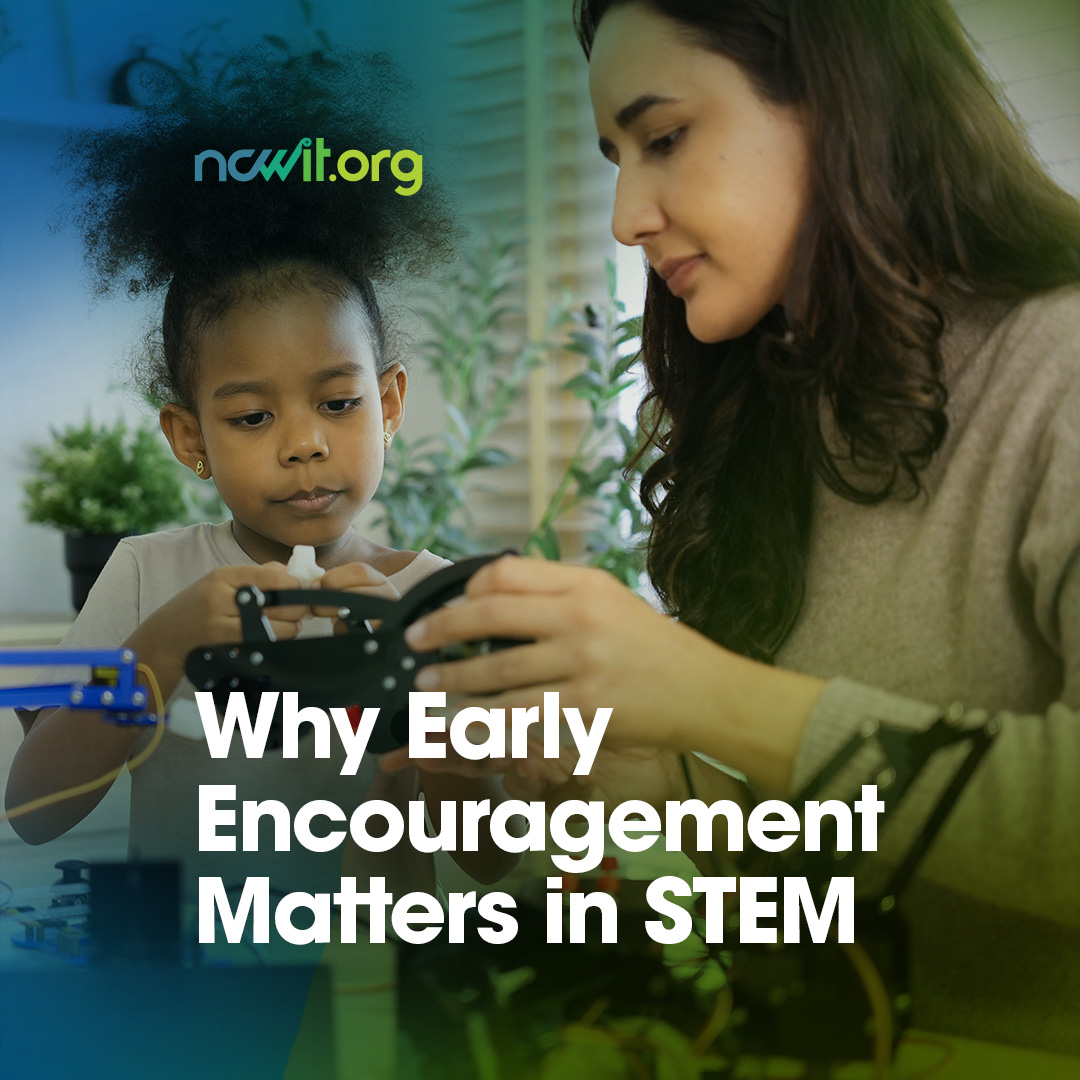
Why Early Encouragement Matters in STEM
Our role as parents and educators is not just to notice interest, but to actively create the environments that make that interest possible.
A Research Brief for Parents and Educators
Many believe that by the time a child reaches middle school, their natural interests have simply surfaced. However, a vast body of research suggests that interest is not a fixed trait. Rather, it is a built attribute fueled by early encouragement, social cues, and prior experience.
The Critical Window for Intervention
While we often wait until high school to talk about careers, the window of opportunity for fostering STEM interest opens much earlier.
- Absorbing Stereotypes by Age 6: By the time children enter the first grade, they have already started picking up on social cues regarding who is expected to thrive in fields like engineering and computer science (Master, Meltzoff, & Cheryan, 2021).
- Early Interest and Persistence: A longitudinal look at practicing scientists found that the vast majority reported their interest was sparked before middle school. Those who developed an interest early were significantly more likely to persist in the STEM pipeline than those who started later (Maltese & Tai, 2010).
- The Power of “Socializers” (Influencers): Interests don’t develop in a vacuum; children rely on parents and teachers to provide the tools, vocabulary, and “permission” to explore technical domains.
Waiting until a student is already choosing electives in 8th or 9th grade is often too late to overcome these early-formed stereotypes. Interest is built through early, repeated exposure.
We Like What We’re Good At
We often assume children simply seek out what they like. In reality, children (and adults) tend to like what they are good at. Psychologists have found that interest and ability are not separate; they function in a reciprocal loop where success in a task creates the desire to do it again.
- The Success Cycle: Early “tinkering” (blocks, logic games, basic coding) provides what psychologist Albert Bandura (1977, 1997) calls “Mastery Experiences.” These are the most powerful source of Self-Efficacy—the belief that one is capable of succeeding. According to Bandura, without this belief in one’s own capability, interest rarely takes root.
- Prior Play Predicts Future Choices: A key longitudinal study by Simpkins, Davis-Kean, and Eccles (2006) found that when children spend their free time on math and science projects during early elementary school, it predicts how much they expect to succeed in those fields later. Basically, the more a child handles technical tools early on, the more they believe they are “good at it” later, which leads to them choosing advanced STEM courses in high school.
- A Question of Experience: When a student says they aren’t “a math person,” they are usually expressing a lack of successful experiences rather than a lack of innate ability. As Hidi and Renninger (2006) outline in their Four-Phase Model of Interest, a deep, individual interest only takes hold after a child has built enough skill to feel competent in the subject.
If we want to spark a child’s interest, the most effective strategy is to help them achieve small, early wins that build their confidence.
Bridging the Gender Gap
While encouragement works for all students independent of gender (PLOS ONE, 2016), the significant imbalance in Computer Science, Engineering, and Physics (CSEP) is driven by distinct, socially-constructed disparities.
The Informal Experience Disparity
By middle school, there is often a large gap in cumulative time spent in unstructured play with technical tools.
- Early Environmental Cues and Availability: “Bedroom audit” studies consistently show that parents provide “thing-oriented” toys (trucks, circuits, LEGOs) to boys months or years before the child can even ask for them (Pomerleau et al., 1990; Rheingold & Cook, 1975). Research by Blakemore and Centers (2005) further found that toys categorized as educational or spatial were significantly more likely to be found in boys’ rooms. Additionally, experimental studies on gender-typed gift giving show that adults are more likely to select STEM-related toys for children they believe are boys, regardless of the child’s actual behavior or expressed interest (Spinney et al., 2023).
- Spatial Literacy as a Learned Skill: Toys like LEGOs and circuits are training tools for spatial reasoning. The brain is highly plastic, meaning it can rewrite its own connections and forge stronger pathways through consistent practice. Because boys are more likely to have these tools available early on, they enter the classroom with cognitive skills that have been sharpened by years of informal training.
- The Illusion of Natural Talent: By middle school, boys may appear “naturally inclined” toward computing and math. In reality, they are often just benefiting from hundreds of hours of informal play. Girls may mistake this prior practice for “innate talent” and conclude they don’t belong (Margolis & Fisher, 2002).
The Encouragement Gap
Despite the universal benefit of encouragement, girls often receive less informal STEM-specific reinforcement and technical feedback. Parents in science museums are three times more likely to explain scientific concepts to boys than to girls (Crowley et al., 2001). Furthermore, adults often perform technical tasks for girls while encouraging boys to do them independently (Tenenbaum & Leaper, 2003). This leads to a confidence gap where girls report lower self-efficacy even when they are outperforming their male counterparts (Cwik & Singh, 2022; Hyseni Duraku et al., 2025; MacPhee, Farre, and Hewitt, 1997).
Culture as a Gatekeeper
How we describe a field determines who feels they belong there.
- Communal vs. Solitary Goals: Research indicates that girls often develop a preference for communal goals (helping others, social contribution). Framing CS as a purely solitary, thing-oriented task creates a perceived identity mismatch (Diekman et al., 2011).
- The Brilliance Myth: Research by Leslie et al. (2015) demonstrates that a field’s gender balance is predicted not by the actual difficulty of the subject, but by the belief that success requires an unteachable “innate spark.” In tech, this myth often presents itself as the “lone genius in a garage” archetype—the idea that you must be a born prodigy to succeed. This cultural notion discourages students who doubt themselves and/or face stereotypes that question their innate talent. By contrast, fields like Neuroscience—which are equally difficult but aren’t culturally associated with the brilliance myth—are much closer to achieving gender parity.
When we frame CS as a collaborative tool for social impact, the interest gap between genders narrows (Cheryan et al., 2013; Beyer, 2014).
Building Interest from the Ground Up
The evidence is clear: the gender gap in STEM fields is highly sensitive to cultural and environmental factors. By providing every child with the experiences and encouragement they need to feel capable, we can build interest from the ground up.
- Encouragement acts as the initial spark, providing the “permission” a child needs to engage with technical tools.
- Consistent experience builds the confidence that eventually presents itself as “talent.”
- Timing matters. Intervening in elementary and middle school helps ensure that interest is not limited by early stereotypes or lack of exposure to formative experiences.
Ultimately, interest is a built attribute. By providing equal encouragement, access, and experience, we can ensure that every student can pursue a path in STEM if they choose to.
References
Allaire-Duquette, G., Chastenay, P., Bouffard, T., Bélanger, S. A., Hernandez, O., Mahhou, M. A., Giroux, P., McMullin, S., & Desjarlais, E. (2022). Gender Differences in Self-efficacy for Programming Narrowed After a 2-h Science Museum Workshop. Canadian journal of science, mathematics and technology education = Revue canadienne de l’enseignement des sciences, des mathematiques et de la technologie, 22(1), 87–100. https://doi.org/10.1007/s42330-022-00193-7
Bandura, A. (1977). Social Learning Theory. Prentice Hall.
Bandura, A. (1997). Self-efficacy: The exercise of control. W.H. Freeman.
Beyer, S. (2014). Why are women underrepresented in Computer Science? Gender differences in stereotypes, self-efficacy, values, and interests and predictors of future CS course-taking and grades. Computer Science Education, 24, 153 – 192.
Blakemore, J. E. O., & Centers, R. E. (2005). Characteristics of boys’ and girls’ toys. Sex Roles: A Journal of Research, 53(9-10), 619–633. https://doi.org/10.1007/s11199-005-7729-0
Cheryan, S., Plaut, V. C., Handron, C., & Hudson, L. (2013). The stereotypical computer scientist: Gendered Media Representations as a Barrier to Inclusion for Women. Sex Roles, 68.DOI 10.1007/s11199-013-0296-x
Crowley, K., Callanan, M. A., Tenenbaum, H. R., & Allen, E. (2001). Parents explain more often to boys than to girls during shared scientific thinking. Psychological Science, 12(3).
Cwik, S., & Singh, C. (2022). Not “a physics person”: How gendered beliefs about ability influence students’ self-efficacy. Physical Review Physics Education Research, 18(2).
Diekman, A. B., Clark, E. K., Johnston, A. M., Brown, E. R., & Steinberg, M. (2011). Malleability in communal goals and public service. Psychological Science, 22.
Hidi, S., & Renninger, K. A. (2006). The four-phase model of interest development. Educational Psychologist, 41(2).
Leslie, S. J., Cimpian, A., Meyer, M., & Freeland, E. (2015). Expectations of brilliance underlie gender distributions across academic disciplines. Science, 347(6219).
Maltese, A. V., & Tai, R. H. (2010). Eyeballs in the fridge: Sources of early interest in science. International Journal of Science Education, 32(5).
Margolis, J., & Fisher, A. (2002). Unlocking the clubhouse: Women in computing. MIT Press.
Master, A., Meltzoff, A. N., & Cheryan, S. (2021). Gender stereotypes about interest in computer science and engineering among children and adolescents. PNAS, 118(48).
Master, A., Tang, D., Forsythe, D., Alexander, T. M., Cheryan, S., & Meltzoff, A. N. (2023). Gender equity and motivational readiness for computational thinking in early childhood. Early Childhood Research Quarterly, 64, 242–254. https://doi.org/10.1016/j.ecresq.2023.03.004
National Science Foundation (NSF). (2021). Women, Minorities, and Persons with Disabilities in Science and Engineering. Special Report.
Pomerleau, A., Bolduc, D., Malcuit, G., & Cossette, L. (1990). Pink or blue: Environmental gender stereotypes in the first two years of life. Sex Roles, 22(5-6).
Rheingold, H. L., & Cook, K. V. (1975). The contents of boys’ and girls’ rooms as an index of parents’ behavior. Child Development, 46(2).
Simpkins, S. D., Davis-Kean, P. E., & Eccles, J. S. (2006). Math and science motivation: A longitudinal study of the links between choices and beliefs. Monographs of the Society for Research in Child Development, 71(4).
Spinney, J., et al. (2023). Gender-typed gift giving: How adults select toys for children. Journal of Applied Developmental Psychology.
Tenenbaum, H. R., & Leaper, C. (2003). Parent-child conversations about science: The role of family gender-role attitudes and children’s gender. Developmental Psychology, 39(1).
Vrieler, T., Nylén, A., & Cajander, Å. (2021). Computer science club for girls and boys – a survey study on gender differences. Computer Science Education, 31(4), 431–461. https://doi.org/10.1080/08993408.2020.1832412