By Dr. Catherine Ashcraft, Director of Organizational Research & Change
A curious storyline is not-so-quietly surfacing in the current business ecosystem. Scroll through LinkedIn or other professional news feeds and the headlines are strikingly similar: “Young and unemployed? Remote work, not AI, may be the problem” or “Remote Work Is Making It Harder for Grads to Find (and Keep) Jobs.” Catchy as these headlines are, they also lay the groundwork for turning remote work into a dangerously convenient scapegoat. Before that happens, now is a good time to take a closer look at the actual evidence.
The Back Story: What The Research Really Says
This emerging storyline is primarily drawing on two studies – the New York Federal Reserve’s Power of Proximity research and the London School of Economics (LSE)/Oxford “Broken Ladder” research. Taken together, their findings highlight two key observations: 1) that the employment gap between junior and senior workers is wider in “remotable” jobs than in “non-remotable” (face-to-face) jobs, and 2) that remote work explains more of the gap than AI-exposure (that is, the degree to which a job’s tasks could overlap with what AI can currently do).
The Proximity research also found that when work moves remote, junior employees receive less mentorship and feedback, making employers more likely to hire senior talent that does not need as much coaching. This dilemma is a valid challenge Corporate America certainly needs to address. It is not, however, an argument for rigid return to office (RTO) policies.
The Nuance Lost in the Noise
Several methodological limitations to these studies make the “it’s work from home not AI” conclusion far from definitive. And to their credit, the studies’ authors acknowledge many of these limitations. Most of the public conversation about their findings does not.
And this is what makes the framing particularly unstable. On one hand, these findings could be a call to action for companies to improve their cultures. A thoughtful leader reads these results as “build better remote onboarding and mentorship structures.” But an employer who already wanted everyone back at their desks reads the exact same findings as a license to mandate RTO. Yet another employer might read the findings as an opportune cover for what are, in fact, AI layoffs.
A Closer Look
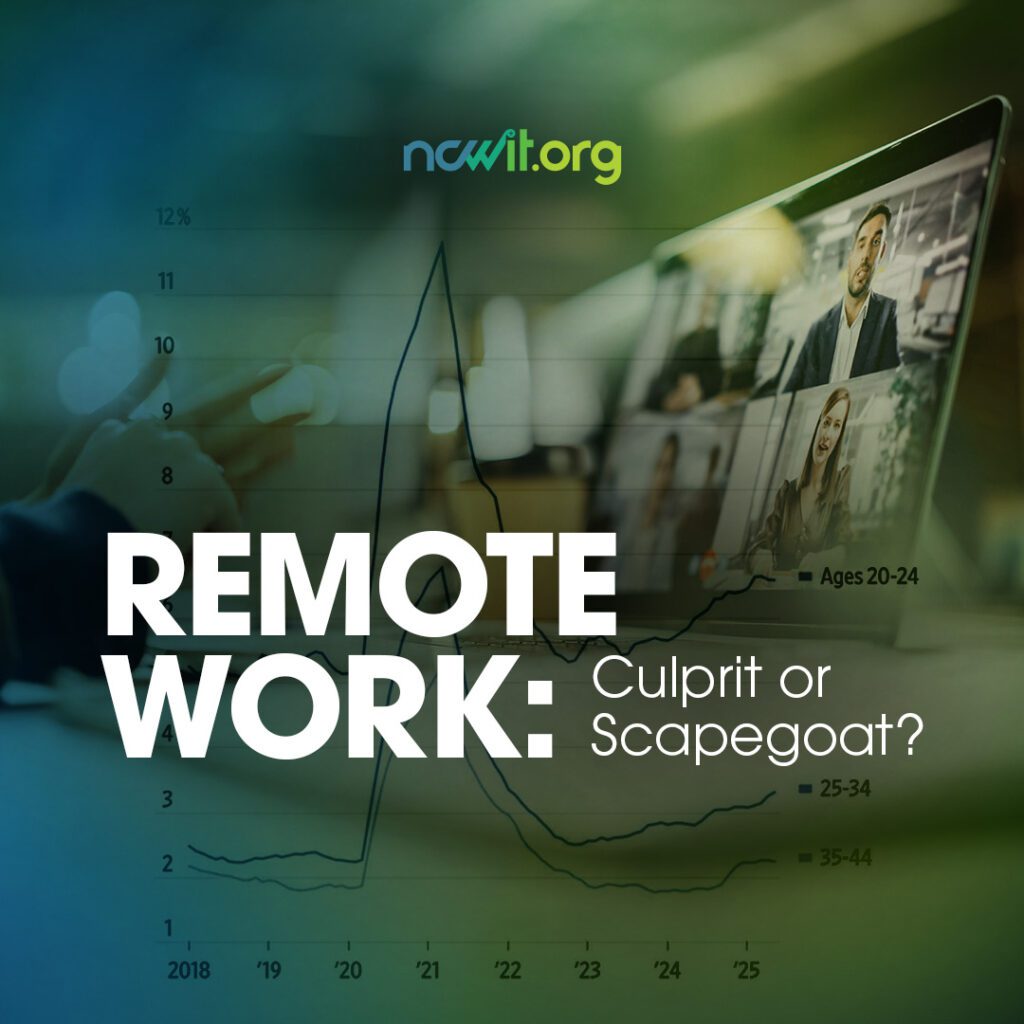
In the Fed’s Proximity data, youth unemployment in remotable jobs rose nearly a full percentage point between 2017-19 and 2022-24, while older workers in those same remotable jobs saw their unemployment rate tick down slightly. In non-remotable jobs, the youth gap barely moved at all. The “Broken Ladder” data tells a similar story at larger scale: across the US, UK, Canada, and Australia, the junior share of new hires has fallen 8 to 11 percentage points below 2019 levels, even as senior hiring has climbed. So it’s true that hiring is not just slowing down across the board; it’s shifting away from junior candidates specifically. And in their analysis, the “Broken Ladder” researchers found that remote work was a better predictor of this shift than AI. But here are some of the key limitations:
The Remotable/AI Conflation: Many “remotable” jobs are also the jobs most exposed to AI automation. In fact, the LSE/Oxford paper observes that there is a 77% correlation between jobs that can be done remotely and jobs that can be automated by AI. That overlap makes it very difficult to cleanly separate the two effects. And indeed, Erik Brynjolfssonand colleagues at Stanford’s Digital Economy Lab find the opposite – that AI exposure itself is the stronger predictor – and this finding holds even after they explicitly test for and exclude occupations amenable to remote work.
Other early-stage indicators add a further wrinkle: senior employees are increasingly the ones managing AI tools directly, doing the work that junior staff used to do as a training ground. If that’s the shift underway, then junior hiring isn’t only dropping because managers find it difficult to mentor people remotely; it may be dropping because entry-level tasks are now being done by a senior person and an AI model. It’s just too early to tell. But if we don’t watch this evolving narrative closely, we may end up with some companies dressing up an AI-displacement reality in a remote work costume.
The RTO “Screening” Effect: As others have pointed out, rigid RTO mandates may often be a tool for quiet layoffs. These mandates tend to “screen out” older, more experienced workers who have more options and higher demands for flexibility, potentially leading them to quit for more flexible jobs. This effect can increase the proportion of junior workers in non-remotable jobs or jobs with rigid RTO mandates.
The AI Data Lag: The timing argument – that remote work is more at fault because this downturn for junior candidates (beginning around 2019) predates the current AI wave — is also shakier than it sounds. First, measuring “AI exposure” only captures potential for automation, not proof of it. If real displacement is still catching up to that potential, these studies may be underestimating AI’s role rather than ruling it out.
Also the Stanford team found employment for early-career workers in AI-exposed occupations has dropped sharply since ChatGPT’s 2022 launch — a finding that directly contradicts the “AI came too late to be the cause” framing. Basically, it is simply too early to see the full labor market outcomes of AI adoption. But again, prematurely pushing this verdict through catchy headlines or careless conversation can open the door for companies to scapegoat remote work for what, in fact, may be future AI-related layoffs.
And The Part That’s Omitted Altogether
The current discussion also leaves out who remote work has actually helped. A substantial body of research documents remote/hybrid work benefits for a wide variety of workers, including younger ones. It has allowed many parents and caregivers to remain in the workforce, while also boosting productivity when implemented well. It’s meaningfully reducedsubtle slights, microaggressions, and other psychosocial hazards of a non-inclusive, in-person office culture. While these slights can resurface in new forms, the benefit for some groups is real, documented, and completely absent from this narrative focused only on what young workers are supposedly costing employers.
The Solution: Cultural Adaptation, Not Mandates
The discussion around these working papers raises vital points worth taking seriously: junior workers need mentoring, and face-to-face time is valuable. But this is a very different claim from “we should mandate rigid RTO for everyone.” Such mandates are a blunt policy response that ignore everything we know about all the benefits of flex work — for parents, disabled workers, neurodivergent employees, and myriad other workers, including the same young workers this narrative claims to be protecting, many of whom took remote-friendly jobs because the traditional office track wasn’t working for them either. So we should beware: If employers start reaching for the “broken ladder” research to justify RTO mandates, they probably aren’t trying to fix the ladder; they’re likely looking for an excuse to kick it over.
There are better answers here. The real solution is thoughtful and intentional leadership and attention to workplace culture. If mentorship is faltering, firms must intentionally replace informal, hallway-style learning with structured feedback and mentoring that work in a hybrid environment. They also should design hybrid models that flex by role and life stage rather than assert a one-size-fits-all RTO policy. We can meet company needs and junior workers’ needs without sacrificing the flexibility that has made work more accessible for parents, caregivers, and millions of other workers. In short, remote work is not the culprit when done right. But it could become a convenient scapegoat if we don’t pay close attention.