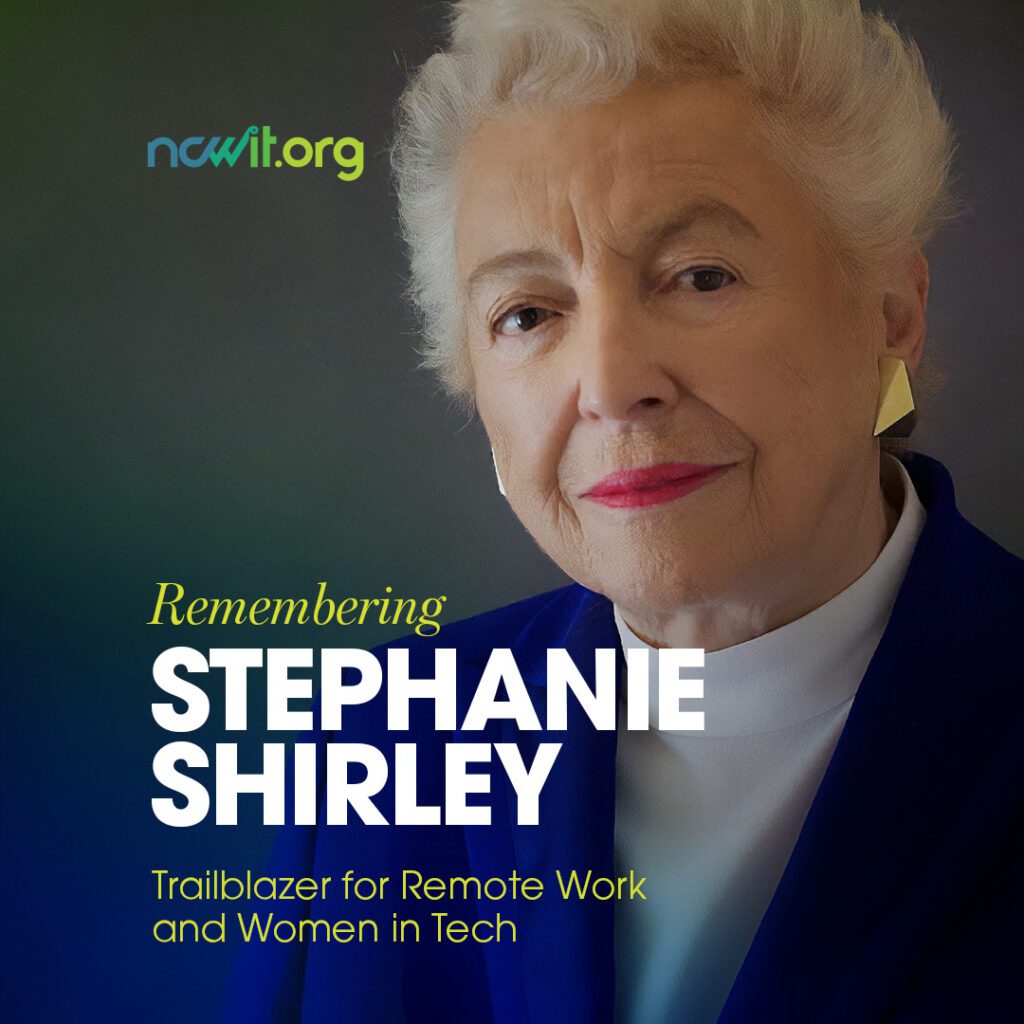
When it comes to role models for women in technology, few have had more impact than Stephanie “Steve” Shirley. Not only was she one of the first to prove that women could thrive in computing, she was also decades ahead of her time in championing remote and flexible work. Shirley passed away on August 9, 2025, at age 91, but her story reminds us why NCWIT’s mission, to broaden participation in computing and unlock innovation through diversity, matters so deeply.
Born Vera Buchthal in Dortmund, Germany, in 1933, she fled Nazi persecution at age 5 and landed in England, where she was raised by foster parents. Gifted at mathematics, she began her career as a mathematical clerk before discovering the emerging field of software programming. But even as her skills grew, opportunities for women remained limited, so she forged her own path.
In 1962, Shirley founded Freelance Programmers, a software company structured around principles considered radical at the time. Employees—almost exclusively women, at least until the Sex Discrimination Act passed in 1975—worked part time, worked from home on flexible schedules, and were hired for their talent, rather than excluded because of their family responsibilities. She was especially interested in hiring women who had been forced to leave traditional jobs when they had children, or who carried the burden of being their household’s breadwinner.
Shirley found that many clients were wary of hiring a company run by women, particularly those who worked from home. Not to be deterred, she found creative workarounds such as bidding for work on a project basis, rather than hourly, to conceal where and when (and by whom) it was done. She also took to using the name “Steve,” a family nickname, instead of “Stephanie.” At its peak, the company employed thousands, and Shirley eventually shared ownership with her employees, turning dozens into millionaires.
After retiring from business, Shirley focused on philanthropy, supporting autism-related causes inspired by her late son, Giles. Her life is a reminder that progress in technology has been as much about people as it has been about machines and code. Shirley proved that creating space for individuals who have historically been excluded makes innovation stronger, workplaces better, and lives richer.
At NCWIT, we see her story as proof of what’s possible, and as a call to keep pushing for the more inclusive future she envisioned.