By Dr. Catherine Ashcraft, Director of Organizational Research & Change
“Meritocracy” and merit are having quite the moment. Maybe you’ve noticed: From Supreme Court rulings to corporate memos to random public commentary, people everywhere are rushing to defend them. But very few are dusting off their dictionaries to define them. And probably for good reason. Defining merit – and achieving meritocracy – are notoriously difficult.
But we’ll give it a try here. This is an oversimplification but for our purposes now, let’s loosely define merit as someone’s accomplishments and performance and meritocracy as a system that rewards people based on merit.
Perhaps nowhere is the fascination with meritocracy more alive than in tech right now (ok, also in politics – or more precisely, at the intersection of the two). To be sure, this is no coincidence. Tech has long clung tightly to the meritocracy ideal – more so than other industries, and today’s political climate has only supercharged that belief — as well as the confusion around it. Since tech cultures are our wheelhouse at NCWIT, now is the perfect time to revisit this not-so-new, but increasingly urgent, conversation.
And we have quite a bit of data on this. For the past 15 years, we’ve kicked off workshops with tech organizations by asking participants whether they agree with the statement: “Our organization is a meritocracy.” The responses are remarkably consistent: a few disagree strongly, a majority agree, and a select few strongly agree. Then the real discussion begins.
Even those who agree, immediately start to qualify their answer:
“Well, we strive to be a meritocracy but it’s difficult to pull off. And what actually counts as merit? We also certainly reward people for things like who they know, who speaks the most in meetings, who went to the “right school,” who can hang with the “bros,” or who has the most charisma or so-called confidence.” And the list goes on.
These data reveal the core dilemma. While we say we value merit, we often reward its proxies: personality over preparation, swagger over substance, and network over know-how. And decades of research backs this up. Despite bold claims, supposed “meritocracies” most often operate more like a hall of mirrors, reflecting the same narrow profiles over and over, while overlooking highly qualified talent that doesn’t fit the traditional reflection.
So the question becomes: How do we fix this? If the mirror’s distorted, what does it take to see talent clearly? The answer: research-based efforts to create more inclusive cultures — that is, cultures where everyone (not just the usual suspects) gets recognized and rewarded for legitimate contributions. But those efforts are now increasingly under attack. They’re spun as “lowering standards” and accompanied by nostalgic calls to return to a golden age when meritocracy supposedly reigned supreme.
Let’s address the lowering standards panic head on. Positioning inclusion and merit as opposites is a false binary. It’s a myth propped up by the distorted mirror that reflects “merit” only in familiar forms. Inclusion, by contrast, is all about seeing merit more clearly. It involves adjusting the lens and lighting to question our assumptions, illuminate where we’ve been shortsighted in recognizing talent, and refine our criteria to reward actual accomplishments and performance. So inclusion is actually laser-focused on raising standards and reducing distortions – making things more meritorious, if you will. And this is perhaps why many resist or fear it – a clearer mirror reveals who’s been winning on illusion, not merit, all along. Enter the urgent plea to restore the original hall of mirrors and return to the aforementioned golden days of meritocracy.
To be clear, no such golden age ever existed. And to be fair, no golden era of inclusion has yet existed either. Have inclusion efforts ever been implemented poorly? Has anyone less qualified ever been hired or promoted amid efforts to improve diversity and inclusion? Sure. While no evidence exists to suggest that this is widespread, we should always work to ensure that this doesn’t happen. But those who like to highlight these instances rarely ask the flip-side of that question: “Have any unqualified people ever been hired or promoted under the traditional systems of the past?” Obviously, yes. And in fact, a great deal of research exists that this pattern has long been widespread.
Psychologist Tomas Chamorro-Premuzic provides an excellent overview of this research in his book Why Do So Many Incompetent Men Become Leaders? He compellingly illustrates how the qualities we often mistake for leadership—overconfidence, charisma, dominance—are more likely to show up in men, and especially in men who aren’t actually that competent. In other words, we confuse confidence for competence, and we reward bravado over intelligence, accomplishments, strategic thinking, or humility. Combine that with a culture that still subtly assumes leadership “looks” male and white, and it’s no wonder we still keep hiring the loudest guy in the room—even when he doesn’t know what he’s talking about.
And dare I say, this phenomenon appears to be on full display right now – in tech, in politics, and beyond. So if we’re sincere, no time like the present to start asking the harder question: “How can we be sure we aren’t promoting underqualified people just because they fit the traditional reflection? To be very clear, there are many talented and highly qualified men who do fit the traditional mold. We should absolutely be hiring and promoting them – right alongside everyone else who’s qualified. Indeed, many of these very men also are being shortchanged right now – even losing their jobs – so they too should feel more than welcome aboard the legitimate merit train!
So Where Do We Go From Here?
First, only talk about meritocracy as an aspirational goal – one that can never be attained but always can be improved. That is, we should stop wasting precious time pretending meritocracy has ever existed — or that it’s ever achievable in some perfected state. I can’t stress this enough. We should say it out loud and often. Fascinating research from Castilla & Bernard highlights what they call the meritocracy paradox: the more confident an organization is in its meritocratic identity, the less likely it is to actually behave that way. So refusing to believe you have attained meritocracy – or ever can – is actually a necessary, but not sufficient, step in remaining vigilant and doing better.
Second: As we’ve said before — and need to keep saying — reject the false binary between merit and inclusion. Stop this in its tracks every time. Inclusion, when done well, is the antidote to lower standards. It helps us recognize the real stuff: skill, results, insight, and filters out the fluff, the flash, and the legacy advantages. That’s not lowering the bar — it’s clarifying and raising it.
Third: Get better at talking about and defining merit. We need better language to more easily distill the difference between merit and its proxies – perhaps something like legitimate merit vs. legacy merit.
- Legitimate merit would be what we claim to value: actual accomplishments, relevant skills, and demonstrated performance.
- Legacy merit would be the proxies we often reward: the things you gain by your association with some type of “legacy” – be it attending the “right” school, being part of the “right” network, or belonging to the gender/race/class that has traditionally held this occupation or role, and so on.
Yes, the term legacy merit may run the risk of (inaccurately) calling these proxies merit at all. But anyone who has tried knows that interrupting real-world conversations — such as hiring, promotion, or admissions discussions —is difficult. Having a quick way to check ourselves can help – a shortcut way for people to stop and ask: “Wait — are we rewarding legitimate merit or legacy merit here?”
Other questions organizations should ask:
- What do we think counts as legitimate merit? Legacy merit? Is legacy merit always problematic? Does what counts as merit shift depending on context or role?
- Should legitimate merit be limited to actual performance or might it also include qualities that research shows to be associated with growth potential and good leadership (e.g., curiosity; vulnerability; willingness to learn/grow; humility).
- How are we recognizing and measuring merit? In what ways might our assumptions or subtle biases shape how we recognize and measure it?
- Should merit only be applied at the level of the individual? To what extent does this inhibit or obscure team collaboration and recognition? (That could be a whole separate blog!)
- And how can we stay vigilant in questioning whether we’re rewarding legitimate merit — or simply defaulting to legacy merit?
To Sum Up
Now’s the time to once and for all retire this nearly ubiquitous myth of meritocracy. It isn’t just a distorted reflection — it’s actively getting in the way. That doesn’t mean we abandon the idea of merit altogether. It means we stop pretending perfection is possible and start doing the work of building imperfect but better systems that are more honest, more inclusive, and more accurate in how they recognize excellence. So let’s ditch the distortion and build something better – a mirror more reflective of the world we want. And that, in itself, is a meritorious goal — well worth the effort.
Interested in Learning More?
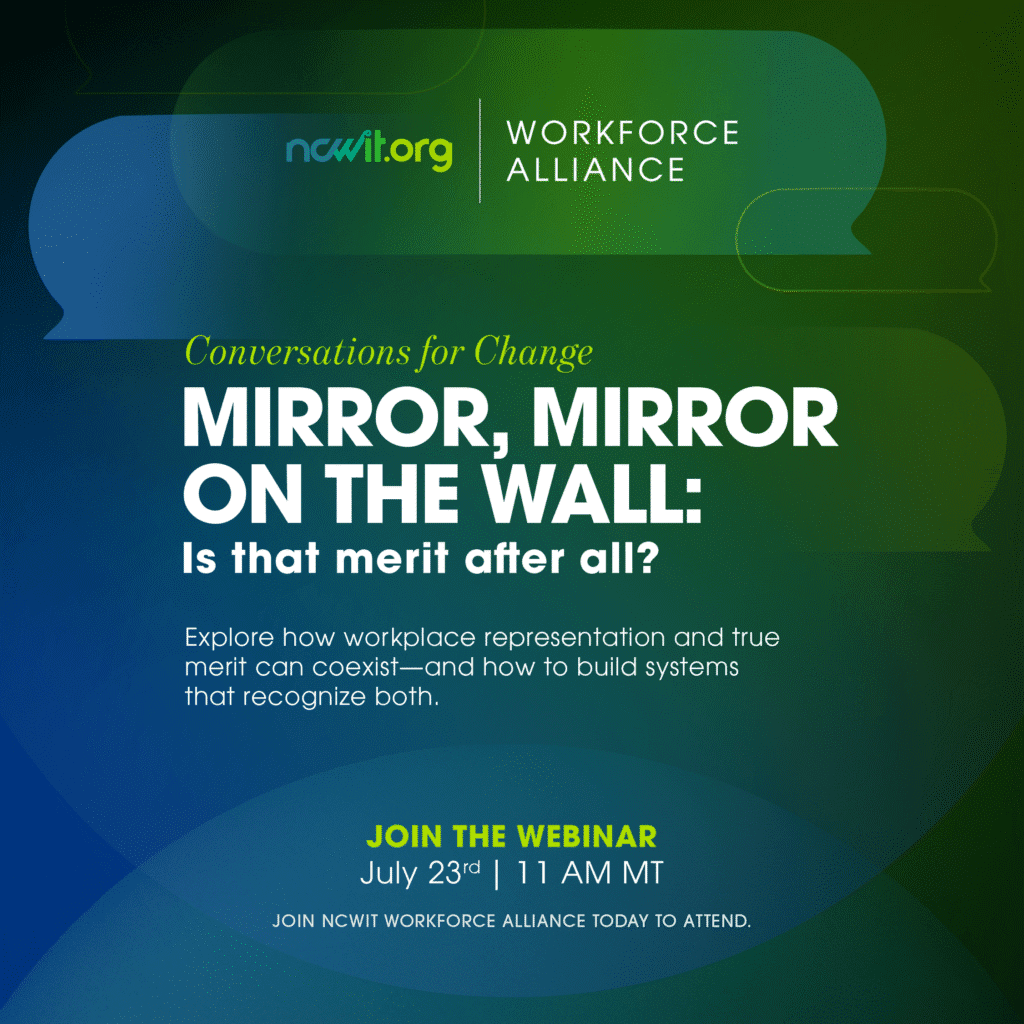
The Workforce Alliance (WA) team is hosting a Conversations for Change event on July 23 at 11 AM MT.
Merit and meritocracy are having quite the moment. Many are rushing to defend them, but few are able to define them. Despite bold claims, our existing workplace and educational systems often function more like a hall of mirrors — reflecting the same profiles over and over while overlooking highly qualified talent that doesn’t fit the mold. Backed by research and real-world examples, this session will challenge the false binary between inclusion and merit and ask: if the mirror’s distorted, what would it take to see talent clearly? Attendees will leave with new language for better ways of talking about merit and practical strategies for building workplace and educational systems that better reflect it.